 AI with Breakfast
Human vs Agent Effort - The Token Economy
 Lee
Lee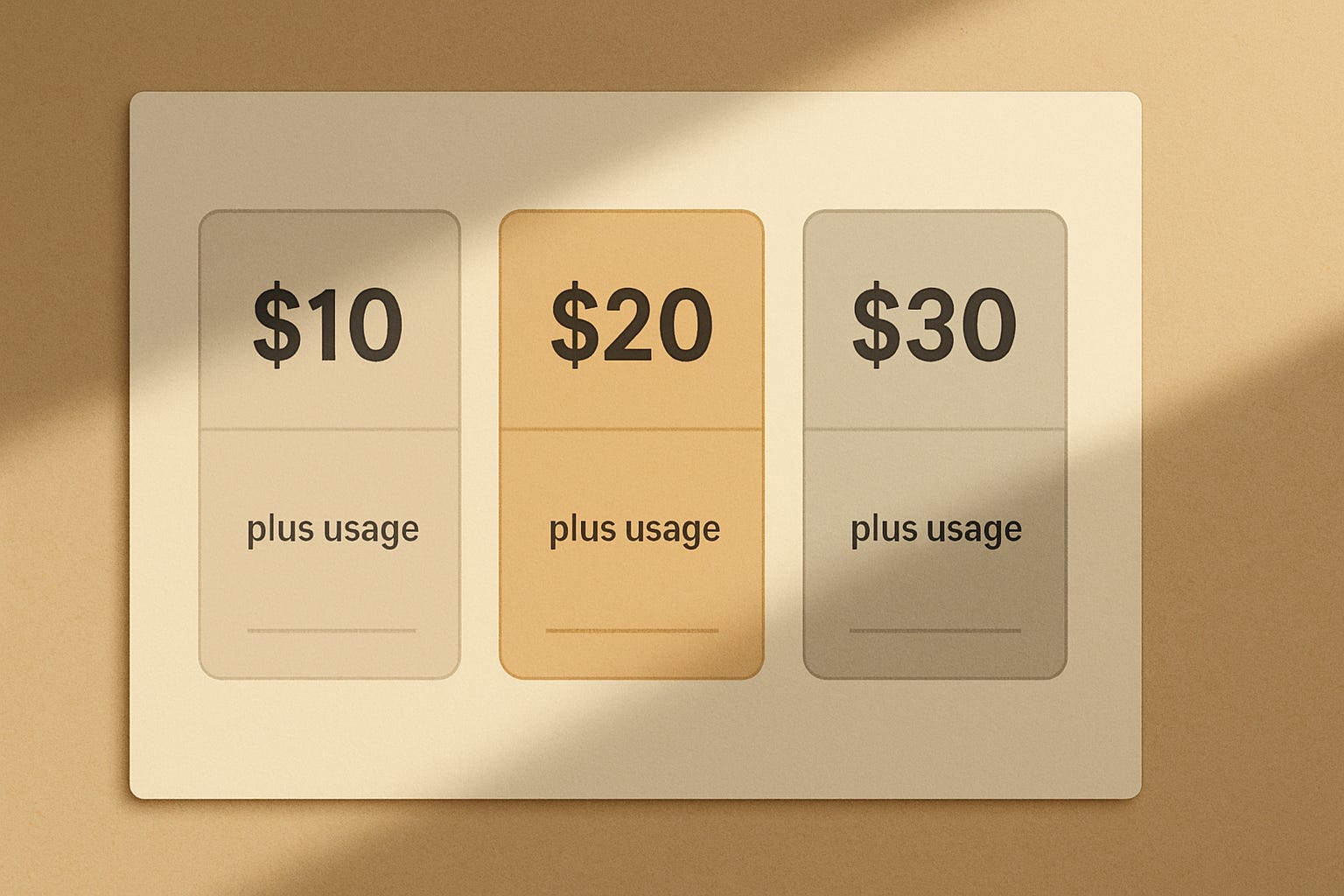
I was looking at a few new tools last week. On each pricing page I saw the same thing across four products. It used to be a flat monthly number: three tiers (nudging you to the middle one), but use it as much as you like.
That was SaaS
Now the monthly fee is still there, but there is a second line underneath it, and that is the one that matters.
Plus usage.
The price was the price for access for you to act. Now the price is bound by what you do, not what you can potentially do. It looks like a simple billing change. It changes how work is counted.
The unit of work is changing.

Tokens Are The New Hours
Before the summer I wrote about the end of time-based value: the hour, our unit of professional worth for over two centuries, collapsing weekly as AI compresses the execution it measured. That article was about what we are leaving. This one is about what replaces it.
Value needs a unit. The hour measured how much human effort a task consumed. The token measures how much compute effort it consumes.
Same job, different executor. Tokens are the new hours.
If the word token is new to you: a token is a fragment of text, roughly three-quarters of a word. Everything you send to an AI model is counted in tokens. Everything it sends back is counted in tokens. You pay for both. Asking the model to "think harder" generates thousands more tokens you never see.
Working in tokens shifts the question from "How many hours will this take?" to "How many tokens will this cost?" and it rewires the economics.
An hour was elastic: a salaried person could have a slow afternoon or a frantic one, and payroll did not move. Effort was pre-paid, so nobody counted it. Tokens are granularly metered at the point of use, itemised, and billed equally and regardless of the output being any good. The person asking the question now sees the price of the answer in real time, even if it is currently obscured by new vocabulary: credits, input tokens, output tokens, cached tokens, reasoning tokens.
We are moving to a world of token time, not human time.
The Problem
This year AI has largely been about business adoption across teams. Adoption has meant experimentation: pilots, champions, a licence for everyone. “Let’s see what sticks”. It has worked, to a point. Most organisations I work with can now show a 15 to 20% productivity improvement and point to real examples: faster drafting, quicker analysis, fewer hours lost to the boring middle of a task.
The trouble is the hype that promises 300 to 400% improvements for everyone has not landed. Yes, some people are doing that (I would count myself in this camp), but most are in the 15 to 20% or at most 50% gains, and that feels like failing next to the headlines. So leaders are pushing harder. More licences. More agents. More tools. More training. More AI KPIs. All driven by the fear that the competitor down the road has unlocked the big gains and will roll over everyone else.

So budgets are pushing too. Token limits are going up even when nobody knows what a year of tokens will cost, because nobody has finished working out the new way of working yet. You cannot budget for a thing you are still discovering. For now this sits under R&D. That was fine while it was small and everyone was learning. Tolerance is dropping, and this is where organisations split.
Those still in experiment mode are about to see the true cost of tokens while the impact stays at 15 to 20%. Those who have adapted their roles will welcome the focus on bigger returns, and the shift away from shiny demoware to real organisational change.
We are moving from time cost to impact cost, and impact is measured in tokens.
The meter is now running and the CFO is asking the obvious question. Is this working? For 500 employees on $200 a month in token credit, you are at over $1,000,000 a year in a cost that nine months ago did not exist. A 15% bump is good. Does it clear a million dollars in gain, and can you show where?
What do organisations do?
Treat AI like people. We do not give every task to the most senior, most expensive person. We do not pay a consultant doctor to review a paper cut. We measure effort, focus on outcome, and match the person to the job.
Today most people use the most expensive model for everything because it is easier. In a usage-based world the price of that habit becomes absurd. An autonomous agent reasoning its way through a task it has seen a hundred times is spending expensive tokens on something that should be a deterministic script. Right tool for the job.
Triage, Then Hand Off
The most valuable job of an expensive frontier model and the tokens it needs shifts from doing the work to understanding it and routing it.
The frontier model looks at the incoming tasks and decides the path. Is this genuinely new and worth real reasoning? Then it reasons. Is it a known shape? Then it writes a detailed task list and hands off to something cheaper: a domain-specific agent, a smaller model that can execute a well-specified plan for a fraction of the cost, or a deterministic workflow that runs the same way every time.

That last option matters most. Faced with a task it will see again, the expensive model's best move is to spend tokens once to produce a script, a rule, a fixed sequence, and then step out of the loop. It does not matter that AI generated the workflow. What matters is that it is repeatable, and that next time it runs nobody is paying for tokens.
Do that across a business and the cost curve stops climbing. It becomes a bell curve: spend rises while the work is being learned, then falls as each pattern is converted into something cheap and/or predictable.
Two caveats. Triage is not free. Somebody still has to check the output. Every token spent on generation creates a small debt in human hours for verification. Time-based cost shows up downstream.
What does it mean for people
The question of cost belongs with the person who owns the outcome, not the person who holds the budget line for software. I have argued before that the value is not in the tool but in owning the outcome. The meter makes that concrete. An outcome should cost as little as possible to reproduce, and you get there by treating compute effort the way you have always treated human effort: measured, matched to the task, and judged on what it delivers.
There will be winners and losers in roles. Some people will thrive at triage, patterning the work and teaching the system what to do next. Others will become the keepers of the library, catching bad answers. A few will stay on the frontier, doing the rare, high-novelty jobs where human reasoning or more likely judgement still pays for itself. AI leaders will need a feel for when not to let an agent run. Procurement will need to learn how to buy outcomes, not minutes.
Finance will be even closer than before, not to clamp down but to help teams see cost in context and to fund the investments that flatten the curve. In a metered world, the bravest, smartest move is often to write yourself out of the work.
What do you do tomorrow?
Name the unit. Put tokens on the dashboard next to time and outcome. If nobody can see the dial spin, they cannot change the wiring.
Stop defaulting to the latest best model. Use the best model to triage, then route to small models, domain agents, or workflows. If you cannot tell which is which, that is your first training session.
Build the library. When a task repeats, spend the tokens once to create a clear, deterministic path. Store the prompt, the code, the checks. Make it easy to call. Treat it as an asset you own.
Assign ownership. Give someone the job of watching for drift and decay. Deterministic is not the same as correct. Schedule spot checks. Decide what gets escalated and when.
Invest in judgement. Train for model choice: when to let an agent run, when to write a script, when to stop asking the machine to think and start asking it to execute. This is the new managerial skill.
Budget for learning, then for flattening. Accept a season of rising spend while the bell curve climbs. Tie the next season's budget to the share of work that no longer needs thinking.
Remember the old way is sometimes still right. A well-written template, a tick-box workflow, or a human expert on a tricky one-off can all beat a long chain of reasoning. Outcome first, method second.
End the week by picking one recurring task and putting tokens, time, and outcome on a single line where the team can see it. Then cut the tokens in half next month.